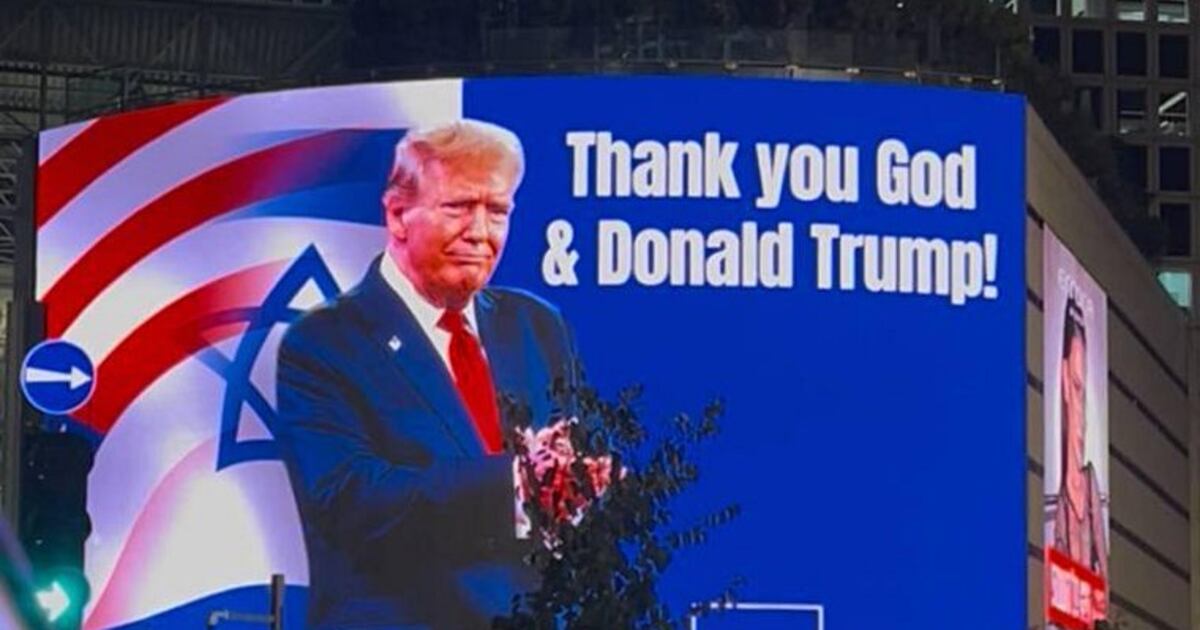
A billboard in Tel Aviv this spring shows a portrait of Donald Trump above the words Thank you God and Donald Trump. A Reuters photographer captured it in March, weeks before Pope Leo XIV stood on the balcony of St. Peter's and called the war between the United States, Israel, and Iran atrocious, saying the name of Jesus should never be invoked to propagate a war. Between those two images sits a question that Christian voters, Pentagon officials, and the president himself have been answering for forty-three days. Is this the war the prophets saw?
What Ezekiel 38 Actually Says
Ezekiel 38 opens with God speaking to the prophet about Gog, of the land of Magog, the chief prince of Meshech and Tubal. Gog leads a coalition that includes Persia, Cush, and Put, riders on horses, a great company with bucklers and shields. The chapter ends with a promise of the coalition's defeat on the mountains of Israel, a scene Ezekiel 39 narrates twice in different terms, which is how Hebrew prophecy signals theological weight rather than chronological repetition. The Gospel Coalition's commentary on the passage is cautious. Ligonier Ministries notes that the precise identity of Gog of Magog is unknown. Serious scholars do not rush past that sentence.
Is Modern Iran the Persia of Ezekiel 38?
Dispensational premillennialism, the framework Hal Lindsey made famous in The Late Great Planet Earth and Tim LaHaye monetized in Left Behind, maps the prophetic coalition onto a contemporary political map. Meshech becomes Moscow. Magog becomes Russia. Persia becomes Iran. Dispensationalism is clear. That is its appeal. The cost is the interpretive confidence it demands from a text whose original hearers were exiled Judeans in Babylon, reading about a restoration they would not live to see. A coalition that includes Paras, the Hebrew word rendered Persia, does appear in Ezekiel 38. Whether the coalition is ancient, future, or literary is a debate as old as Christian commentary on the book, and good-faith interpreters land in different places.
 Bipi News
Real-Time, Evidence-Based News Reports
AI-powered investigative reports tailored to your interests. Sourced, verified, and delivered in real-time.
Create Free AccountWhat Jesus Said About Dates
But concerning that day and hour no one knows, not even the angels in heaven, nor the Son, but the Father only. — Matthew 24:36
In the Olivet Discourse, which runs through Matthew 24, Mark 13, and Luke 21, Jesus tells his disciples they will hear of wars and rumors of wars. His next sentence is that the end is not yet. He then lists signs: famines, earthquakes, persecutions, the gospel proclaimed to all nations, a great tribulation. At the center of the passage sits the verse above, and six verses later, the command to watch because you do not know the hour. In Acts 1:7, when the disciples ask about the timing of the kingdom, the risen Jesus answers: it is not for you to know the times or seasons the Father has set by his own authority. The New Testament is consistent on this point across authors and genres. Christians are told to watch and to work, and not to predict.
The Rapture Debate Christians Don't Hear About
Bipi NewsThink Further on BIPI.
Unlimited access to your personalized investigative reporter agent, sourcing real-time and verified reports on any topic. Your personalized news feed starts here.
Learn morePaul's language in 1 Thessalonians 4, about believers being caught up to meet the Lord in the air, is where the English word rapture originates, via the Latin rapio. Dispensationalists read the passage as a distinct pre-tribulation removal of the church, a reading that took wide evangelical hold through the Scofield Reference Bible in the early twentieth century. N.T. Wright, one of the most-read New Testament scholars of the past half-century, argues the passage describes Christ's return and the gathering of believers, not a secret removal. Amillennialism, held by most Catholics and most of the Reformed tradition, reads the thousand-year reign of Revelation 20 figuratively. Pew Research found in 2022 that 63 percent of white evangelicals say we are living in the end times, while 70 percent of Catholics and 65 percent of mainline Protestants say we are not. Two billion Christians do not share one eschatology.
Franklin Graham Called Trump Esther. Pope Leo Called the War Atrocious.
Pew Research 2022: 63 percent of white evangelicals say we are living in the end times. 70 percent of Catholics and 65 percent of mainline Protestants say we are not.
Verified
Franklin Graham, in public remarks since the first strikes, has likened Donald Trump to the biblical Esther, the Jewish queen who, according to the Hebrew Bible, was elevated by God to save her people from annihilation in ancient Persia. Ken Peters of the Patriot Church in Tennessee told his congregation he hoped the war would yield a pro-Israel, pro-America Iran, a line his Reuters video shows drawing applause. Paula White-Cain, senior adviser to the White House Faith Office, likened Trump to Jesus at an Easter event last week, saying both were betrayed and arrested and falsely accused. Robert Jeffress, the Dallas pastor who laid hands on the president, told Reuters the war is a spiritual war between good and evil, between the kingdom of God and the kingdom of Satan.
It is the same language as the crusades of the Middle Ages. You know, we must stop the infidel, we must defeat the wicked. We've never seen anything like this in American history. — John Fea, professor of American history, Messiah University
“The name of Jesus should never be invoked to propagate a war. — Pope Leo XIV, Palm Sunday homily at St. Peter's Square
Who
Franklin Graham — American evangelist and son of Billy Graham, has likened Donald Trump to the biblical Esther, the queen of ancient Persia who saved her people from annihilation.
Bipi NewsKnow someone who should read this?
Share this report with a friend who values evidence-based journalism.
Russell Moore, editor of Christianity Today and the former head of the Southern Baptist Convention's public policy arm, wrote in June that Jesus never said we would know exactly when the end would come. The Military Religious Freedom Foundation filed a complaint in early March alleging that a combat-unit pastor told soldiers President Trump has been anointed by Jesus to light the signal fire in Iran to cause Armageddon and mark his return to Earth. Defense Secretary Pete Hegseth has cited scripture to justify what he called overwhelming violence against enemies who deserve no mercy. On Easter Sunday, Hegseth compared the rescue of a downed American airman to the resurrection of Jesus Christ. The Pentagon did not retract the comparison, and no major evangelical institution dissociated itself from the framing either.
Reuters/Ipsos poll: 60 percent of Americans oppose US strikes on Iran. Republicans back the war 74 to 22; Democrats oppose 22 to 74.
Verified
Timeline
March 2, 2026 — A combat-unit pastor reportedly told soldiers Trump had been anointed by Jesus to light the signal fire in Iran, according to a Military Religious Freedom Foundation complaint.
How Should a Christian Live Right Now?
Scripture does not give believers permission to disengage from moral accountability because the signs look dark. It gives the opposite command. In 2 Thessalonians 3, Paul rebukes believers who stopped working because they thought the day of the Lord had arrived. In James 1, the mark of pure religion is caring for orphans and widows in their distress. In Matthew 25, the final judgment separates people not by their eschatology but by how they treated the hungry, the sick, and the imprisoned. Thirteen American service members have died in this war. Thousands of Iranians have died. An infant was killed in south Lebanon on Saturday during her father's funeral, according to the Reuters wire. Every one of those deaths is a person made in the image of God. An eschatology that can absorb those numbers into a prophetic countdown without pausing to grieve has stopped being Christian theology.
Watch, the Bible says. Work, the Bible says. Witness, the Bible says. None of those commands translates into celebrate bombs because a coalition including Persia appears in Ezekiel 38. The call on any believer living through this week is to refuse two easy failures. The first is the panic that treats every headline as the penultimate chapter and every dead Iranian as a verse confirmed. The second is the cynicism that treats the prophets as myth and the suffering as politics. Between them sits the narrow path the Gospel asks Christians to walk. Pope Leo said it on Palm Sunday. The name of Jesus should never be invoked to propagate a war. That sentence is not political weakness, and it is not theological liberalism. It is what the Prince of Peace taught, and what his Church has confessed for two thousand years.